Goal this lesson: Understanding tokens (the atoms of text generation), probability distribution (how the AI picks the next word), neural network structure (the basic architecture), and attention mechanisms (where the model focuses as it generates).
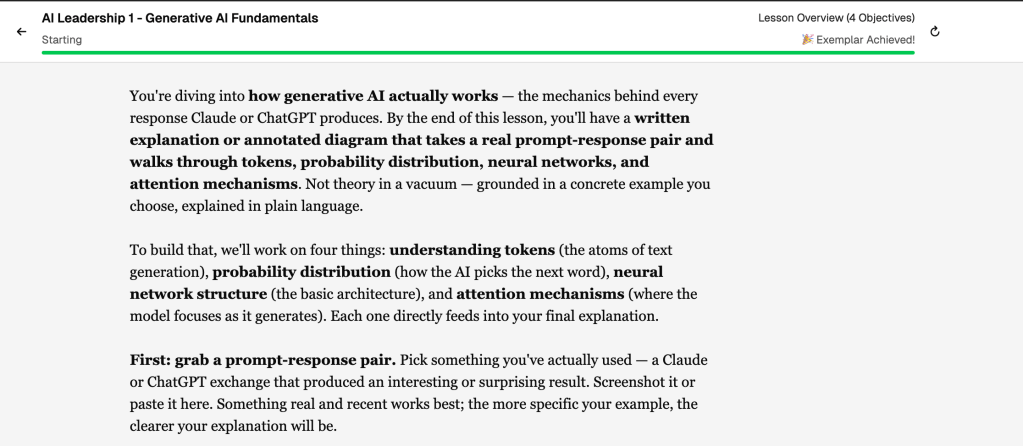
AI generates responses by predicting the most likely next token based on the prompt and the tokens that came before it. Tokens are pieces of text, such as words or parts of words, that AI uses to process and generate language.
For example, if the prompt requests a legal brief and includes the phrase “The law should provide a,” the model recognizes legal writing patterns and is more likely to select a term such as “remedy” rather than “solution.” This occurs because the prompt, prior tokens, and legal context increase the probability that “remedy” is the most appropriate choice.
Within the model, hidden layers identify patterns, evaluate context, analyze the purpose and tone of the prompt, and rank possible token choices. The output layer then assigns probabilities to candidate words and selects the option that best fits the context.
In simple terms, AI pays attention to key phrases and context much like a person reading carefully. When it encounters terms such as “law,” “legal brief,” or “constitutionality,” it adjusts its language to match a formal legal writing style, producing responses that are more precise and contextually appropriate.
Goal this lesson: Written explanation or diagram that walks through the 4 steps of agentic AI (Perception → Reasoning & Planning → Acting → Learning & Adapting), grounded in a real example, and connects those mechanics to a concrete implication for work in law or professional development.
Understanding agentic AI changes how I approach completing tasks that i know will need to be done in the future. To save time for other more important duties, agentic AI can collect data and make every result better than the past. In my search for a job or internship it can be used to develop new resume’s or personal statements taking what found responses and what didn’t. It doesn’t just end here; it will continue to develop as my workload and job life increases.
Goal this lesson: Dissect one of my AI projects. In that analysis, I identified (1) what objective the AI system was built for, (2) the AI component itself — what it takes in, what it produces, (3) specific gaps, errors, hallucinations, or bias you found, (4) how well the output actually meets that objective, and (5) the decision points and checkpoints where a human needs to step in to catch problems before they matter.
The objective was to create a study guide that would help us study for the test. It included everything in that unit, in chronological order. The failure was the examples it failed to analyze. It connected something in page one like the glacier to something random in the lithosphere from a later page. To prevent failures next time I will implement user checks by everyone in the group, I will have claude check itself, and I will compare the accuracy from Claude with other Ai programs. Overall I think that it was very helpful but It leaves ucnertainty in the air. It makes me second guess everything in the study guide. If I don’t do the gates to check, it can be very inaccurate and send me in the wrong way.
Goal this lesson: Identifying my pre-use expectations (time/resource savings and output quality), evaluating actual results against those predictions, and analyzing the concrete factors that shaped the outcome
For this assignment, I used ChatGPT as a drafting tool rather than a one-step solution. I provided a detailed prompt that included legal terminology, contract-specific sections, and instructions to organize the content chronologically. The initial output followed the requested legal structure and incorporated the tone and organization I specified. While some portions of the response became more general than intended, I refined the output through a follow-up prompt and completed the remaining edits myself to ensure accuracy and consistency with the assignment requirements.
The final contract outline included the parties to the agreement, recitals, definitions, scope of work, term and effective date, compensation provisions, confidentiality obligations, intellectual property rights, representations and warranties, indemnification and limitation of liability, termination provisions, and governing law and dispute resolution clauses. Because the original prompt was specific, only minor revisions were required, making the drafting process significantly more efficient while still requiring my review and final edits.
Goal this lesson: Crafting prompts that pull diverse ideas from AI, evaluating which ideas are actually worth my time, and documenting my iteration rounds.
Using this scheduling exercise showed me that AI outputs often improve through multiple rounds of prompting rather than a single request. I initially asked for a work schedule, then provided additional constraints regarding my class schedule, work hours, recovery time after shifts, and mock trial preparation needs. By comparing multiple versions and refining the prompts, I was able to create a schedule that better matched my actual responsibilities and preferences.
This experience demonstrated the importance of iterative prompting. Rather than accepting the first response, I evaluated each schedule, identified what did and did not work, and provided more specific instructions to improve the result. In the future, I plan to apply this approach to mock trial preparation by using separate prompts to explore different case theories, cross-examination strategies, opening statements, and evidence priorities. I can then compare the results, identify the strongest approach for a particular case, and refine it further through additional prompting and independent analysis.
Goal this lesson: Identifying my monitoring system (where and how I stay aware of new tools), spotting a gap in my current workflow that a new tool could fill, and documenting my integration strategy.
As an incoming law clerk, I will be expected to review and synthesize large amounts of information efficiently. To develop this skill, I used Claude to summarize the Harvard Law Review article Habeas Class Actions by Brandon L. Garrett Kovarsky and Alan Z. Rozenshtein Rave. The AI-generated summary accurately identified the article’s central argument, the legal authority supporting habeas class actions, the impact of recent Supreme Court decisions, and the limitations imposed by AEDPA on post-conviction class litigation.
Using AI allowed me to quickly identify the article’s key points and determine its relevance without reading the entire publication first. I then reviewed the summary against the source material to verify its accuracy and ensure that important legal concepts were not omitted. This process demonstrated how AI can assist with document review and legal research by accelerating information gathering while still requiring human verification and analysis.
To continue developing these skills, I regularly monitor legal publications and news sources for articles related to legal technology, document review, and case management. I plan to use AI-assisted summarization to evaluate new materials efficiently while maintaining responsibility for reviewing sources and drawing legal conclusions.
Goal this lesson: Identifying real AI ethics risks in legal work, articulating my personal values and boundaries, and designing a simple checkpoint process.
As a future attorney, I believe legal professionals must remain responsible for the substance of their work. Attorneys, judges, clients, and families rely on accurate legal analysis, so AI should support research and review rather than replace independent judgment. My approach is to conduct my own analysis first and then use AI to identify issues I may have overlooked, refine legal arguments, and test alternative strategies.
To maintain that standard, I follow a structured review process: I read and brief cases independently, compare my work to AI-generated summaries, re-explain the material in my own words, and identify which insights came from my analysis versus the AI output. In addition, every Monday at 8:00 a.m., I review work completed without AI and compare it to an AI-generated brief to evaluate accuracy, identify gaps, and improve future research.
My interest in law is rooted in protecting and advocating for others. I view AI as a tool that can strengthen legal preparation by improving organization, issue spotting, and argument development, but responsibility for the final analysis must remain with the attorney. My perspective on ethical legal practice is influenced by the values I learned from my family, particularly my grandparents, who emphasized integrity, accountability, and doing what is right.
Goal this Lesson: Have a concrete living wage figure for my location, a specific career direction (grounded in my law clerk goal), 3–4 preparation steps I have already taking or will take, and a wage negotiation strategy for when I am interviewing for that role.
As part of the AI Leaders program, I researched the cost of living in Chicago and found that a living wage for a single adult is approximately $25.80 per hour, or $53,600 annually. This exercise helped me connect career planning with financial realities and better understand the economic goals I will need to meet as I enter the legal profession.
My long-term career goal is to become an attorney. While I am still exploring specific practice areas, I am particularly interested in labor law, education law, and intellectual property law. Through the AI Leaders program and my legal internship at an AI healthcare company, I have seen how artificial intelligence is creating new legal questions involving workplace policies, education, healthcare, intellectual property, and liability. These experiences have strengthened my interest in developing legal expertise in areas affected by emerging technology.
Over the next 18 months, I plan to increase my GPA, prepare for the LSAT, continue my legal internship through May 2027, and secure a law clerkship for summer 2027. After law school, I intend to begin my legal career in Chicago, where I have researched entry-level attorney salaries and developed realistic compensation goals based on local market conditions.
This course and the AI Leaders program have provided practical experience with artificial intelligence that complements my legal studies. In addition to earning an AI micro-credential, I have applied AI in academic, leadership, and professional settings, helping me build skills that will remain relevant as technology continues to influence the legal profession.
 harrisonAILEADERS